

Demineralization Plant
Two-bed/Mixed-Bed/EDI DM for ultra-low TDS process and lab water.
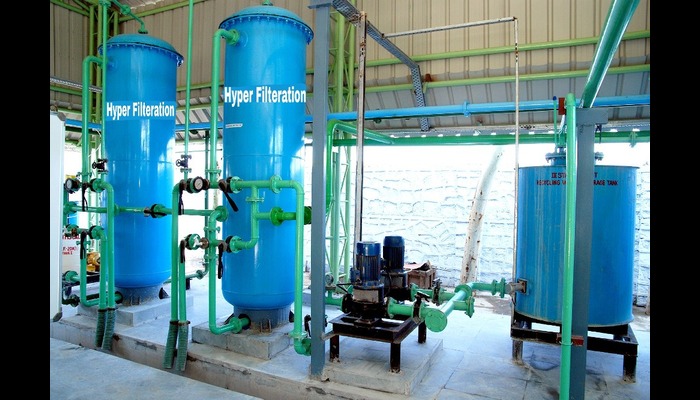

A demineralization plant is a water treatment facility designed to remove dissolved mineral salts and ions, such as calcium, magnesium, sodium, chloride, sulfate, and bicarbonate, from water to produce high-purity or deionized water. This process is primarily achieved through ion exchange resins in a staged sequence involving cation and anion exchange.
Design and Process
-
The demineralization process typically employs two main ion exchange columns: one with a strong acid cation resin that replaces mineral cations (e.g., Ca2+, Mg2+, Na+) with hydrogen ions (H+), and another with a strong base anion resin that replaces anions (e.g., Cl−, SO4²−, HCO3−) with hydroxyl ions (OH−).
-
The H+ and OH− ions released combine to form pure water (H2O), effectively removing dissolved salts.
-
Sometimes a mixed-bed unit, containing a mixture of both cation and anion resins, is used after the dual beds for further polishing to produce ultrapure water.
-
Pre-treatment steps such as filtration or clarification often precede the ion exchange process to remove suspended solids and protect resin beds.
-
Regeneration of exhausted resins involves chemical treatments with acid (for cation resins) and caustic (for anion resins) solutions to restore ion exchange capacity.
-
Additional units like degassers may be included to remove dissolved gases such as CO2, and ultrafiltration systems may be used for colloidal silica removal.
Applications and Uses
-
Providing high-purity water for boilers and steam generation in power plants, preventing scale formation and corrosion.
-
Supplying ultrapure water for pharmaceutical manufacturing, electronics, and semiconductor industries.
-
Producing process water for industrial applications requiring minimal dissolved solids.
-
Used in laboratories and medical facilities for controlled water quality.
-
Essential for industries requiring water free from mineral contaminants to protect equipment and product quality.
Key Benefits
- Power generation plants where high-quality boiler feedwater is critical.
- Chemical and pharmaceutical manufacturing plants.
- Electronics and semiconductor fabrication facilities.
- Laboratories and research institutions.
- Any facility that demands consistently high-purity water beyond typical softening or filtration systems.
- Used as process water in the textile industry. Refineries and steel plants: Used in various processes, including cooling water and other production steps